Advent Calendar Study 2025: “Open the door, brand failed? Brand touchpoint quality of branded Advent calendars”

40 million Advent calendars are sold in Germany every year. And they are no longer just for children: over a quarter of Germans buy an Advent calendar for themselves – often branded Advent calendars.

But are such branded Advent calendars just short-term sales promotion measures or valuable touchpoints that bring the brand to life and strengthen it in the long term?

Using the Brand Touchpoint Quality model, master’s students at the HWR Berlin, led by Prof. Dr. Carsten Baumgarth, examined and evaluated 14 Advent calendars (a total of 107 evaluations). Not only was the evaluation of Advent calendars a meaningful and motivating exercise for a course in the master’s program “Brand Management,” but the evaluation and additional expert assessment by Prof. Baumgarth also yielded some insights:

  • Branded Advent calendars remain popular with German consumers. In many cases, the calendars are purchased for personal use.
  • Advent calendars can and should be much more than mere sales promotion tools and should be interpreted and designed much more as powerful brand touchpoints.
  • Shelf power: Ensured by size, colorfulness, and (unusual) format. Historical examples can serve as inspiration.
  • Usability: Ensure that the doors can be opened easily and that all items do not slip or become damaged during transport; inclusive design (e.g., Braille) is an interesting design approach.
  • Experience: most important driver with the dimensions of emotion, inspiration, multimodality, surprise, becoming active, and social experience; however, in the study, this BTQ dimension received the lowest average rating.
  • Experience: Variety in content, surprise (e.g., competitions, vouchers), exclusive content (e.g., merchandise), inspiration through interesting information (e.g., back side, QR codes), opportunities for participation, and becoming active yourself are some design approaches for enhancing the experience.
  • Brand: Recognizability of key brand assets and brand values are the second most important driver. Despite all the brand codes, the calendar should also include “Christmas” images and themes.
  • The price-performance ratio should be perceived as “fair” from the customer’s point of view.
  • The BTQ model can be used as a frame of reference for the development of Advent calendars; at the same time, the BTQ model can be used as an approach for evaluation by experts and/or consumers.

We would like to thank the following companies for sending us Advent calendars: Kloster Kitchen, Laverana, Primavera, Ronnefeldt, Sawade, Seeberger, and Teekanne.

The complete study presentation can be downloaded here (sorry only in German).

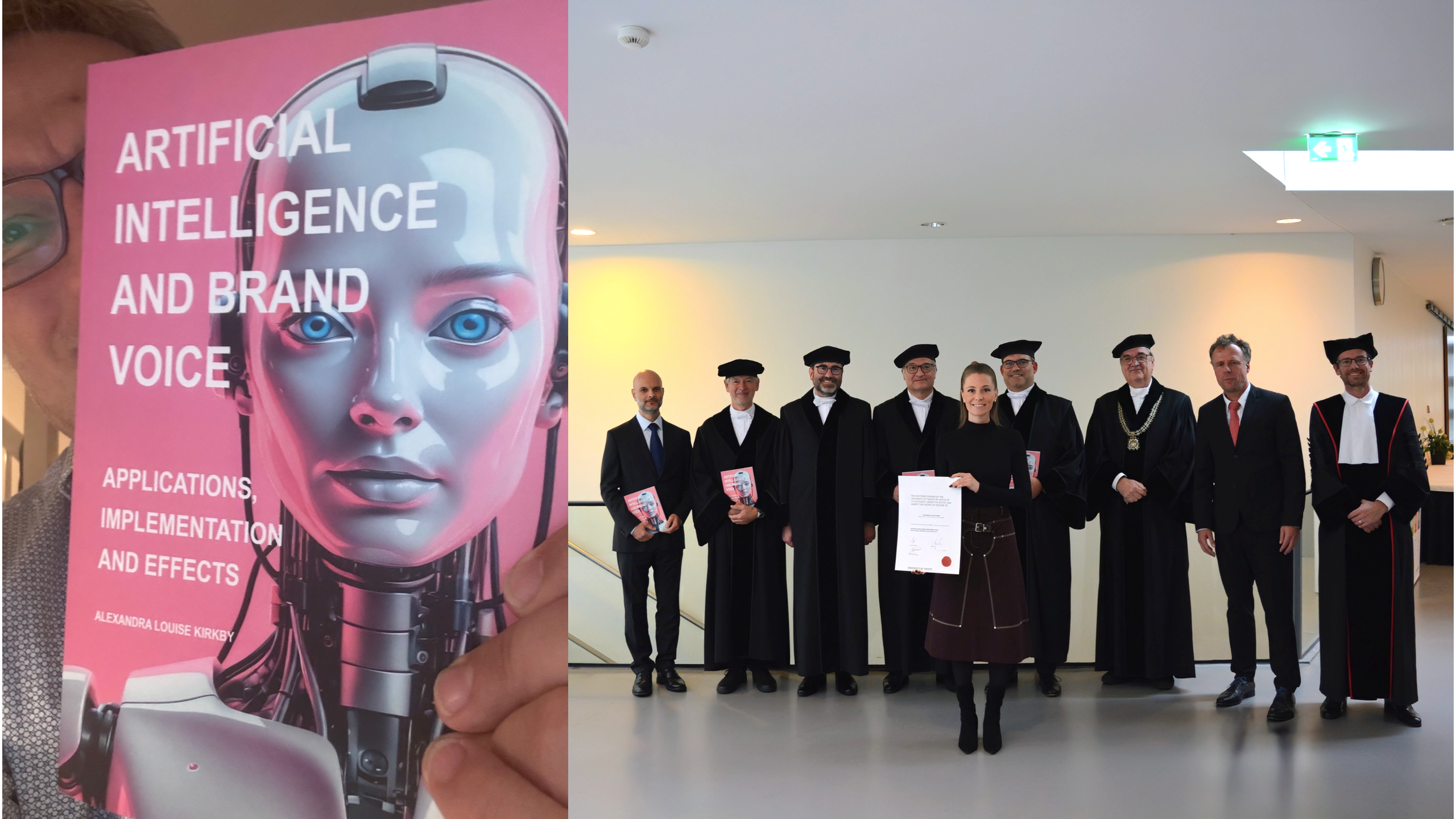
Successful PhD Completion by Dr. Alexandra Louise Kirkby under the supervision of Prof. Dr. Carsten Baumgarth

The Professorship for Brand Management at HWR Berlin is pleased to announce that Dr. Alexandra Louise Kirkby, a long-standing research associate and lecturer of the faculty, successfully completed her PhD at the University of Twente (Netherlands) on October 3, 2025.

Dr. Kirkby was part of the team for six years, contributing extensively to teaching and research while pursuing her doctoral studies in cooperation with the University of Twente in the Netherlands. Supervised by Prof. Dr. Carsten Baumgarth at HWR Berlin and Prof. Dr. Ir. Jörg Henseler at the University of Twente, her cumulative dissertation explored the role of Artificial Intelligence (AI) in brand management, with a particular focus on brand voice.

The dissertation is available via the following link. We warmly congratulate Dr. Kirkby on this outstanding achievement and wish her continued success in her academic and professional career.

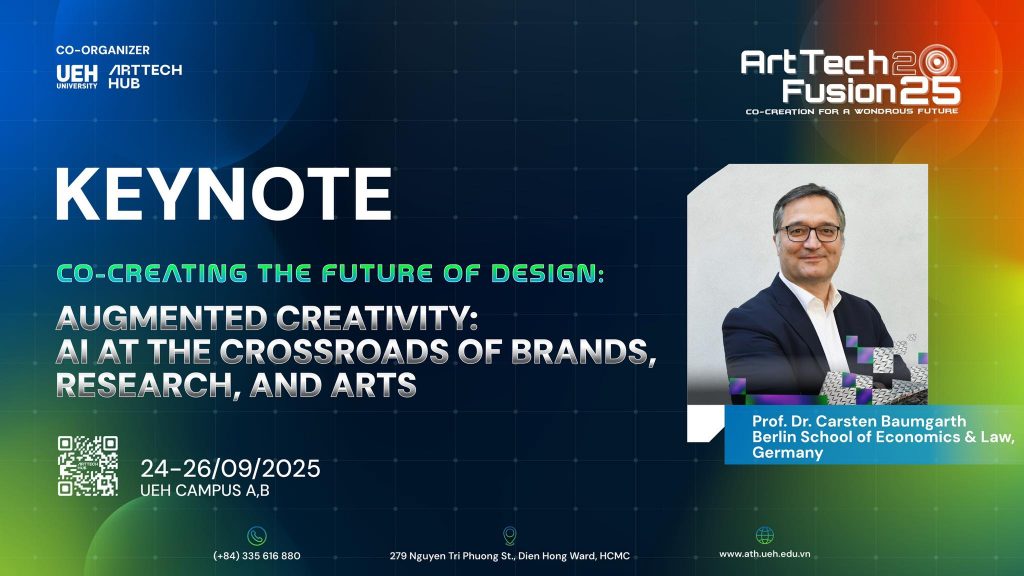
Keynote speech at ArtTech Fusion 25 in Ho Chi Minh City (Vietnam)

AI solves routine tasks, but can it also help with creative tasks?

Yes, but only if people use AI sensibly as a partner (AUGMENTED CREATIVITY). In his keynote speech “Augmented Creativity: AI at the Crossroads of Brand Management, Research, and Arts,” Prof. Baumgarth introduced the concept of augmented creativity and presented use cases from the fields of brand management, research, and art.

Augmented Creativity has great potential and has the following positive effects, among others:

  1. AI as a creativity tool
  2. Expansion of creative boundaries
  3. Democratization of creativity
  4. Creation of new jobs

However, the emergence of AI in the creative field also has a downside. Among other things, the following negative effects are to be expected:

  1. Transparency dilemma, algorithm aversion, and blurred boundaries
  2. Design fixation and “more of the same”
  3. Algorithmic bias
  4. Loss of creative jobs
  5. Intellectual property and legal concerns

The slide deck is available here.

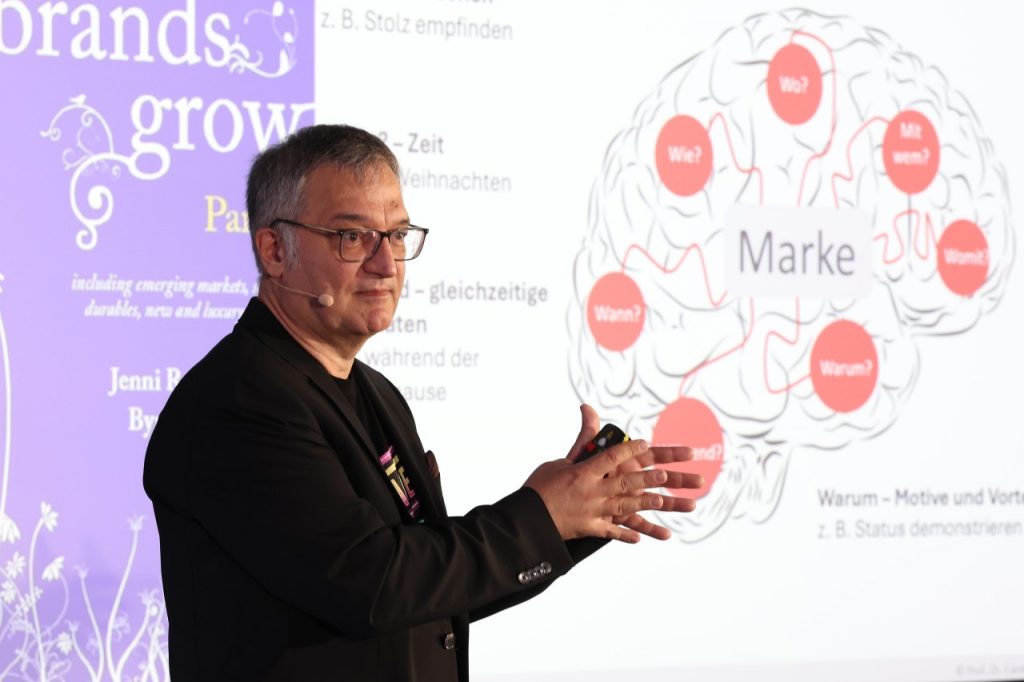
Keynote “Augmented Brand Intelligence by AI” – Horizont Advertising Impact Summit 2025

Nano Banana & Co. can easily and impressively produce images and modify existing ones. Anyone can also produce text, video, and sound at the touch of a button. But this does not make brand management more professional or increase its effectiveness. This requires collaboration between humans and machines. We refer to this collaboration as augmented brand intelligence. It is more a matter of combining knowledge (e.g., from science – top journals), mental models, and precise use case descriptions with prompting and AI capabilities and the “right” AI tools.
At this year’s Horizont Advertising Impact Summit, Prof. Baumgarth illustrated this human and AI synergy using four use cases:
1. Visualization ideas for communication using proprietary GPTs based on “classic” creativity techniques, which are available for every subsequent project after creation.
2. Brand-consistent communication through few-shot prompting and models such as the OCEAN model.
3. Assessment of the prospects for success of Dove brand transfers through the integration of a scientific meta-analysis from an A+ journal.
4. Identification of growth opportunities for the Rivella brand through the integration of the Category Entry Points model.

The slides from the keynote speech (sorry, only in German) are available here.

Foto credit: Alexander Hassenstein

New book published: Brand Tools II – New Brand Sprint

Together with his colleague Prof. Dr. Dirk-Mario Boltz, Prof. Baumgarth has published a new brand tool book as part of the essential series. The book covers a Google Sprint-based methodology for developing a meaningful brand positioning in three hours. The approach is based on a design research approach, and the book presents the tool using the example of the start-up SecondRide. The tool is suitable for companies, especially SMEs and start-ups, but also for teaching purposes. The book is available in all digital and physical bookshops, can be ordered on the SpringerGabler platform, and is available via Springer Nature Link.

New AfM working group “AI & Brand(ing)” founded

As part of this year’s Arbeitsgemeinschaft für Marketing (AfM) conference at the TH Rosenheim, the new working group “AI & Brand(ing)” was launched. The AfM is the network of all marketing professors at universities of applied sciences in the DACH region.

The new working group will focus on the impact of AI on marketing teaching, practice, and science. More than 60 AfM colleagues want to get involved in the work of the new group in the future. Approximately 20 colleagues attended the founding meeting in Rosenheim, where they discussed the first work packages in detail. The following four keynote speeches highlighted different aspects during the founding meeting:

  • Prof. Dr. Ulrich Bucher (Baden-Württemberg Cooperative State University Stuttgart): From classic to AI-supported: A comparison of two approaches to empirical research
  • Prof. Dr. Carsten Baumgarth (Berlin School of Economics and Law): AI art infusion effect
  • Prof. Dr. Mahmut Arica (FOM University of Applied Sciences for Economics and Management): Practical AI tools for marketing
  • Prof. Dr. Gunnar Mau (Magdeburg-Stendal University of Applied Sciences): Chatbots as a touchpoint for students.

Prof. Dr. Carsten Baumgarth (HWR Berlin) initiated the AI & Brand(ing) working group and acts as its spokesperson.

AI Garage for Brands x 18th Global Brand Conference (Porto)

Prof. Baumgarth and Dr. Steffen Schmidt delivered the keynote speech “Augmented Brand Intelligence by AI for practice AND science” at the 18th Global Brand Conference. The keynote speech presented the following five characteristics of Augmented Brand Intelligence:

(1) AI is accepted and integrated into brand work and brand research as a fully-fledged team member.

(2) The specific use case and not the features of tools form the starting point for augmented brand intelligence.

(3) Brand tasks, systems, and use cases require a meaningful combination of tools from different AI classes combined with human intelligence and expertise.

(4) Brand managers and researchers can only use augmented brand intelligence if they have extensive skills and expertise (e.g., mental models, data, creativity, critical thinking, and domain expertise).

(5) The Humans are responsible for the precise description of the task, the selection of the most suitable (AI) tools, the input request, the administration of the required data, and the interpretation and critical reflection of the AI results (“in-the-loop”).

The application of Augmented Brand Intelligence was then demonstrated for various practical (brand positioning) and scientific use cases (literature review, scale development, replication, science communication).
Finally, two hot topics were presented using AI agents and synthetic data.

The slides can be downloaded here.

Science x Practice: New project with MetaDesign and eye square

AI is everywhere! But does it feel human, personal … and on BRAND?

Brand practice and brand science revolve around different orbits. The project “Building Brand” tries to connect these two worlds. Prof. Baumgarth is particularly pleased when these encounters result in concrete collaborations on exciting and relevant brand topics.

One such collaboration is the “AI Conversation Branding Study 2025” project with partners MetaDesign, eye square & Hochschule für Wirtschaft und Recht Berlin.

The aim was to analyze whether and how AI-generated chatbots can be designed as brand touchpoints in real time in a brand-oriented way. To this end, a mental model (OCEAN personality model) was used as a fine-tuning approach for ChatGPT, and experts and consumers were confronted with these chatbots in several studies.

The key findings are:

  1. Chatbots ≠ cost center – they demonstrably boost brand strength.
  2. OCEAN fine-tuning ensures a consistent brand voice – otherwise, there is a risk of brand violations and generic small talk.
  3. Strong power brands? Need fewer fine-tuning, because their brand values and brand tonality are already embedded in the training corpus of the LLMs.

More information about the study and the opportunity to try out the approach can be found here.

AI Garage for Brands x 24th International Marketing Trends Conference

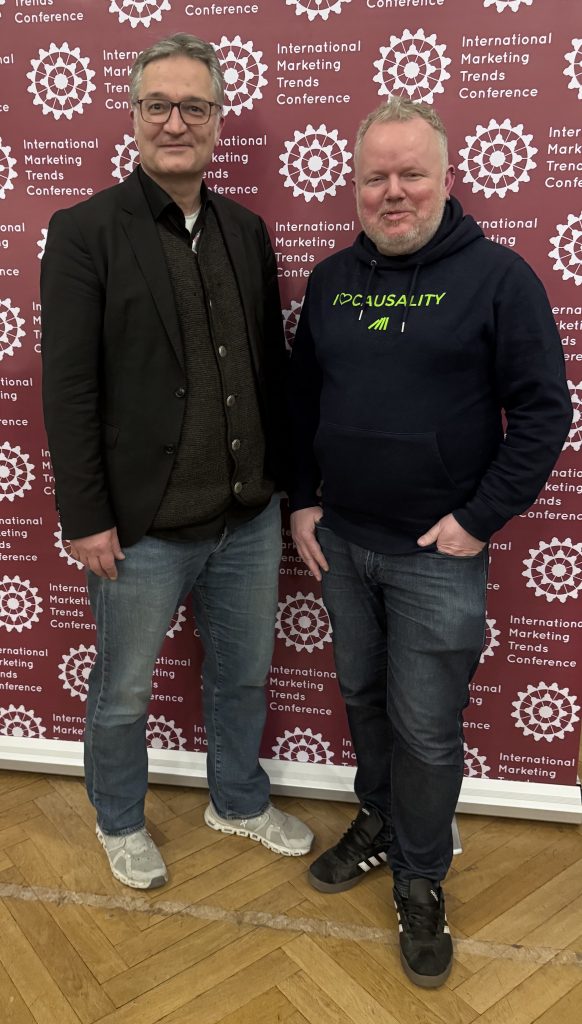
Today, Dr. Steffen Schmidt and Prof. Dr. Carsten Baumgarth presented our concept of augmented brand intelligence in a three-hour workshop moderated by Prof. Dr. Klaus-Peter Wiedmann at the 24th International Marketing Trends Conference in Venice. We explained the collaboration of human and artificial intelligence for use cases from both brand practice and brand science. The slides can be downloaded here.

B*lab report – No. 6 is published

Research results should be available as quickly as possible. Our B*lab report working paper series, launched at the end of 2020, is designed to help with this. The sixth edition, which has now been published, presents the best work of master’s students from the “Advanced Brand Management” course from the summer semester of 2024. This special issue focuses on the connection between AI & Co and brand management. The three selected papers cover a spectrum from AI bias in the beauty industry to the perception of AI content and a discussion of the impact of AI on the working world in advertising agencies. You can download the issue here.